
Chart Overview
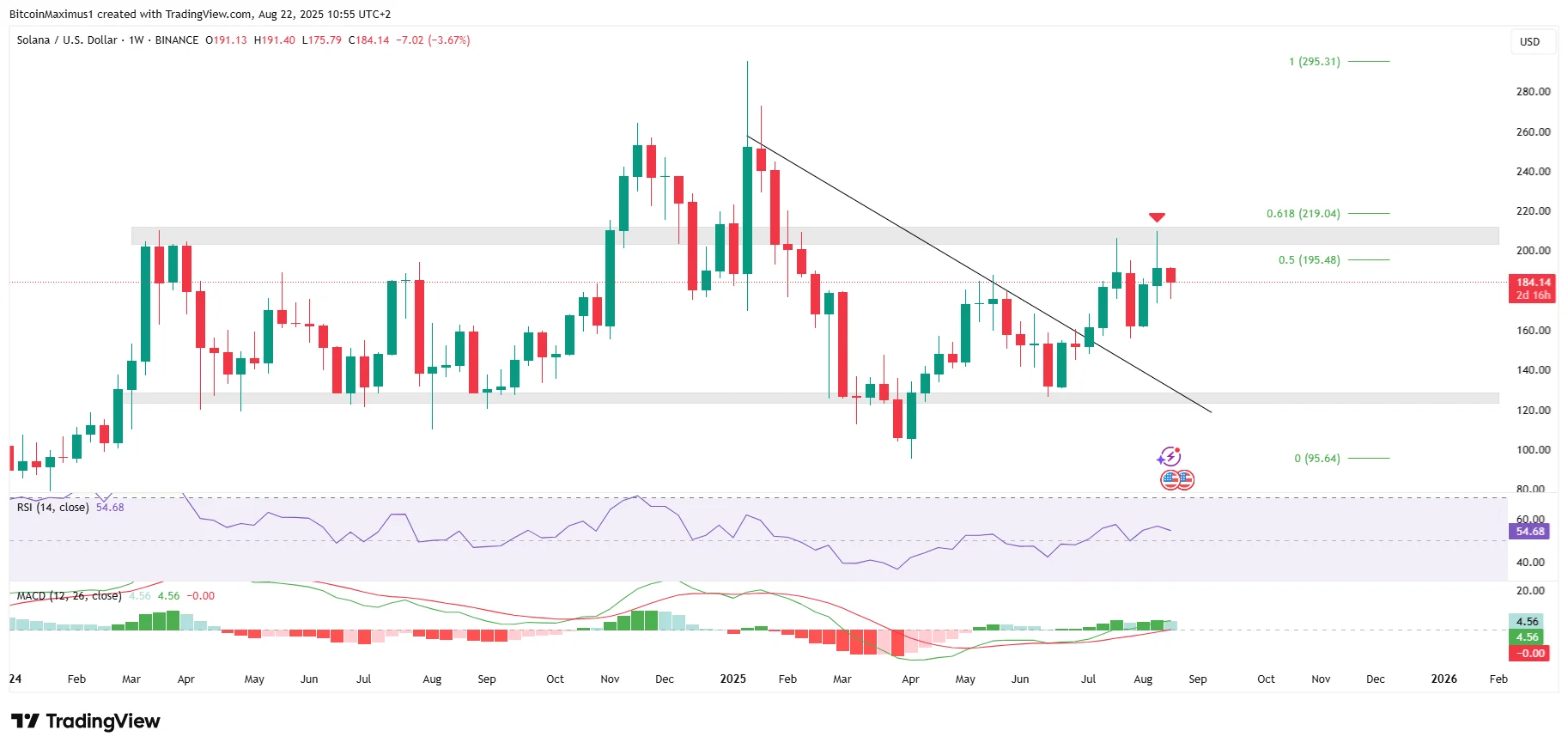
The SOL/USD (Solana vs. U.S. Dollar) weekly chart shows a crucial rejection from the 0.5 to 0.618 Fibonacci zone, indicating hesitation among buyers after a strong recovery phase.
Solana recently touched $219 (0.618 retracement) but failed to close above the mid-resistance range near $195, hinting at possible consolidation or a pullback.
Key Observations
The highlighted zones in the chart reveal major structural levels:
- Resistance Range: $195 – $219 (Fibonacci 0.5–0.618 zone)
- Support Zone: $120 – $130
- Long-Term Fibonacci Low: $95
- Target Resistance: $295 (Fibonacci 1.0 extension)
These levels represent areas of institutional interest where liquidity often gathers — ideal for studying reaction patterns.
Trendline & Market Behavior
A visible descending trendline from prior highs was broken recently, signaling an early shift in structure.
However, after the breakout, Solana faced supply pressure at the Fibonacci mid-zone, indicating the market may be testing strength before continuation.
The gray horizontal boxes illustrate zones of historical accumulation and rejection — classic signs of a market transitioning from recovery to decision-making.
RSI Analysis
The Relative Strength Index (RSI) currently hovers around 54.6, reflecting a neutral but slightly bullish tone.
When RSI holds between 50 and 60 on higher timeframes, it often suggests that buyers are maintaining control, though not aggressively pushing price higher.
If RSI drops below 50, it could mark the beginning of a deeper correction phase.
MACD Structure
The MACD (12, 26, close) indicator continues to show positive momentum, with green histogram bars confirming gradual bullish pressure.
However, both signal lines are flattening — a common sign of momentum slowdown before either a retest or a trend continuation.
If the histogram turns red again, that would confirm a momentum reset within the ongoing structure.
The Range Battle
Solana is currently locked between:
- Support Base: $175 – $180
- Resistance Cap: $195 – $220
This tight range can lead to false breakouts, especially during lower trading volume periods.
For educational purposes, such phases are ideal to study how buyers and sellers balance control before a decisive move.
Volume & Sentiment
Volume levels have slightly declined compared to earlier breakout candles — this shows profit booking and market indecision rather than strong reversal intent.
A renewed rise in volume during an upside retest could signal confidence returning toward the next Fibonacci extension zone near $295.
Educational Takeaways
From this setup, traders and learners can observe:
- Fibonacci retracements act as natural psychological checkpoints for profit-taking.
- Trendline breaks are not confirmations — watch for horizontal retests.
- RSI neutral zones (50–60) help identify balanced but cautious momentum.
- MACD flattening often signals a cooldown phase, not immediate reversal.
- Multi-zone mapping gives better clarity than focusing on single price points.
Broader Context
Solana’s overall trend remains constructive as long as weekly closes stay above $150.
This analysis, however, focuses on understanding structural behavior, not forecasting price.
Learning to read such setups teaches timing, patience, and clarity — essential traits for disciplined market observation.
Conclusion
The Solana weekly chart demonstrates a textbook example of resistance testing within a recovery phase.
While the structure shows promise, the reaction at $195–$219 will define short-term momentum.
For learners, this serves as a valuable case study on how Fibonacci zones, RSI, and MACD interact to reflect evolving sentiment.
Disclaimer: This article is purely for educational and analytical purposes.
It does not constitute financial or investment advice. Always perform your own research or consult a certified advisor before trading or investing.