
Chart Overview
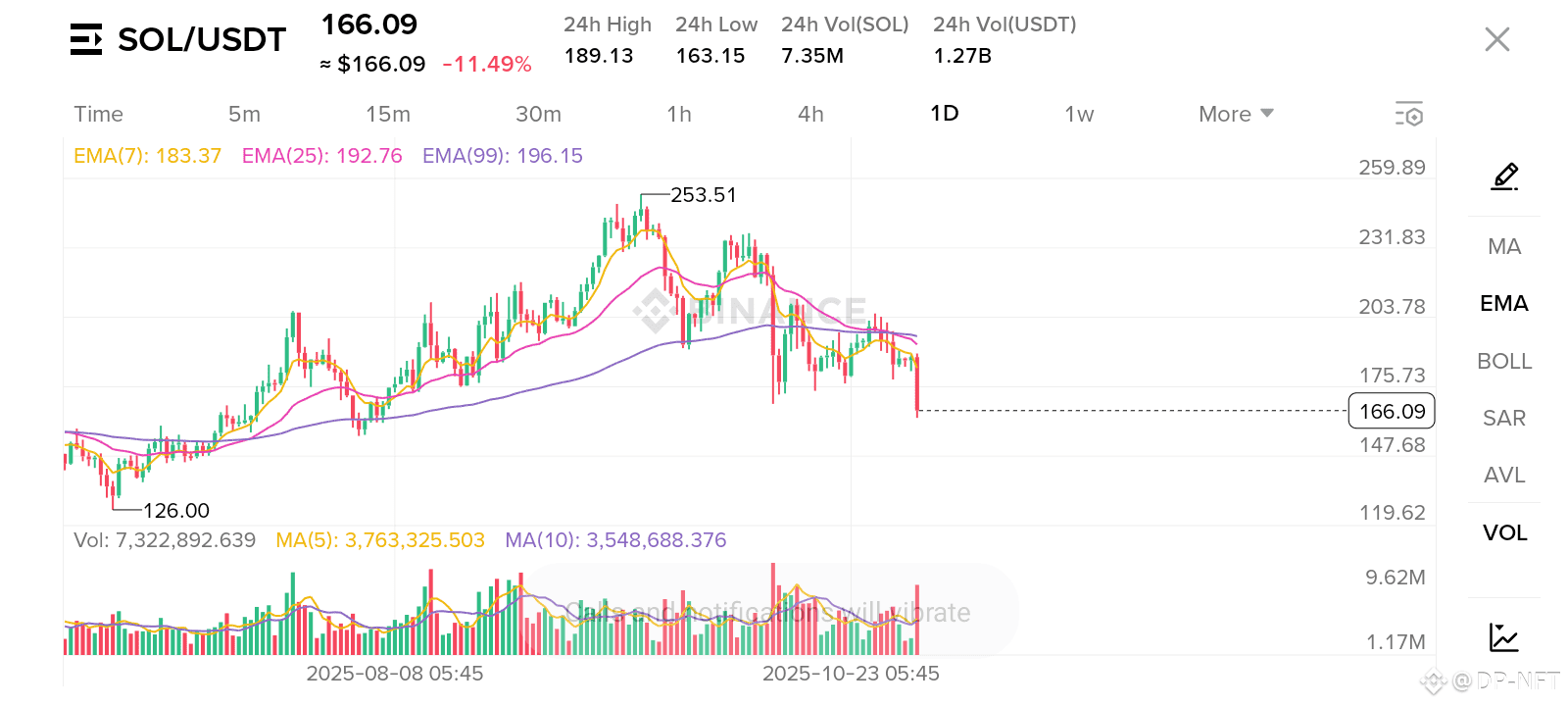
The SOL/USDT (Solana vs. U.S. Dollar) daily chart captures a clear EMA breakdown setup, where momentum has shifted from short-term optimism to caution.
After weeks of sideways trading above the $180 level, Solana’s price fell sharply to around $166, signaling an early loss of control by buyers.
Key Observations
The chart highlights three crucial exponential moving averages (EMAs):
- EMA (7): $183.37 — short-term trend gauge
- EMA (25): $192.76 — medium-term momentum line
- EMA (99): $196.15 — long-term dynamic support
Price has decisively closed below all three, marking the beginning of a potential trend transition from accumulation to distribution.
The Breakdown Structure
After reaching a high near $253.51, Solana started forming lower highs, indicating waning demand.
The rejection candles around $190–$200 formed a visible supply zone where sellers regained control.
Now, as price trades near $166, the structure resembles a clean breakdown below the EMA cluster, often considered a bearish continuation sign.
The slope of shorter EMAs turning downward further confirms the shift in market sentiment.
Support and Resistance Levels
Solana’s current chart provides clear reaction zones where traders can expect price behavior:
| Type | Level (Approx.) | Description | |------|------------------|--------------| | Resistance | $183 – $190 | Confluence of EMA and prior supply | | Support 1 | $160 – $150 | Immediate short-term demand zone | | Support 2 | $126 – $120 | Major base formed during previous rally |
A close below $150 could expose the price to deeper corrections toward $126, while a strong reclaim above $183 would neutralize the bearish bias.
Volume Confirmation
The volume histogram shows rising red bars during the drop, suggesting that the recent move is supported by genuine selling pressure.
Declining volume in recovery candles implies buyer hesitation, a common trait in early-stage downtrends.
If volume expands again on a retest rejection near $183, the probability of continuation toward lower support zones increases.
Understanding the Market Behavior
This chart setup provides an excellent example of how EMAs act as dynamic levels of confidence:
- When price trades above all EMAs — the trend is healthy.
- As each EMA flips from support to resistance — momentum weakens.
- When all EMAs align downward — sentiment becomes decisively bearish.
The $183–$190 confluence zone now serves as a strong educational example of a resistance cluster where multiple timeframes align.
Educational Takeaways
Traders studying this setup can extract key lessons:
- EMA crossovers visually represent trend shifts — faster EMAs always react first.
- Volume alignment with breakdowns adds conviction to the move.
- Support-loss confirmation occurs when price retests and fails to reclaim the lost level.
- Patience after breakdowns prevents emotional entries during volatility.
- Round levels like $150 or $200 carry psychological significance for large players.
Broader Context
While this is a daily timeframe analysis, the same breakdown logic applies across timeframes.
Understanding how EMAs compress and separate helps traders recognize momentum exhaustion, trend transition, and potential reversals early — a crucial skill for swing traders and position holders.
Conclusion
Solana’s current structure reveals a textbook EMA breakdown setup, emphasizing the power of trend-following logic.
Whether the next move is a retest toward $183 or continuation to $150, this case visually demonstrates:
- How EMAs define structure shifts,
- Why volume validates sentiment, and
- How disciplined observation outweighs prediction.
Learning to read EMA behavior through structure, rather than relying on signals, builds a deeper understanding of price psychology — the foundation of every reliable trading decision.
Disclaimer: This content is designed purely for educational and informational purposes.
It is not financial or investment advice. Always perform independent research or consult a professional advisor before trading or investing.