
Chart Overview
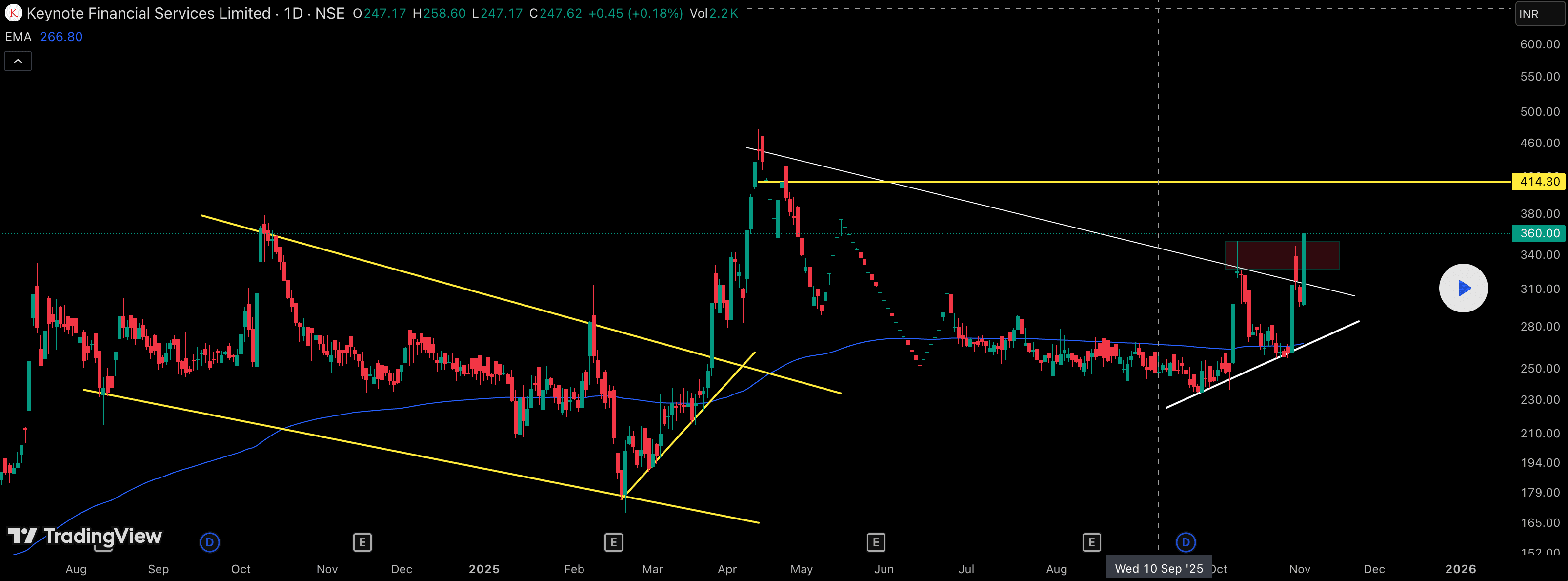
The daily chart of Keynote Financial Services Ltd (NSE) offers a perfect study example of how trendline breakouts and momentum shifts occur in stock price action.
The setup clearly shows multiple descending and ascending trendlines, each representing a change in market sentiment over time.
After a long phase of consolidation and range-bound activity, the stock recently witnessed a breakout above a declining trendline — a moment that typically signals renewed buying interest and possible strength in momentum.
Understanding the Downtrend Channel
In the earlier part of the chart (August 2024 – March 2025), price moved within a downward-sloping parallel channel marked by two yellow trendlines.
This pattern is commonly called a falling channel, characterized by:
- Lower highs and lower lows,
- Gradual decline in volume, and
- Consistent selling pressure.
However, towards the end of the channel, price began stabilizing — forming a potential base.
This is often the first sign that sellers are losing dominance, allowing buyers to gradually return.
The Breakout Signal
The breakout above the upper yellow trendline around late March 2025 is the defining moment in this chart.
What makes this breakout notable:
- It coincided with a rise in volume, confirming renewed market participation.
- The stock also crossed above the 200-day EMA (blue line) — a widely followed long-term indicator of trend direction.
- The move broke the pattern of lower highs, hinting at a trend reversal.
Such setups are valuable educational examples of how a shift in market structure looks visually.
The Retest and Rising Trendline
After the breakout, prices often return to test the breakout zone — known as a retest.
In this chart, the price gently pulled back toward the newly drawn ascending white trendline, confirming the area as short-term support.
When a retest holds:
- It validates buyer confidence,
- The trendline becomes a dynamic area of support,
- And it sets the stage for potential upward continuation.
The current rising white line under the price action shows that momentum remains intact as long as price stays above this structure.
Resistance and Target Observation
On the upper side, the chart highlights a short-term resistance zone near ₹340–₹360, where the price paused after a sharp rally.
This area, shown in a shaded red rectangle, marks a supply zone — a region where sellers have previously been active.
Above that, there’s a longer-term horizontal resistance around ₹414, which aligns with the chart’s past highs.
This level acts as a potential Target-2 observation zone, not as a prediction but as an educational example of how historical price memory affects future movements.
EMA Influence
The Exponential Moving Average (EMA) line at around ₹266 adds context to the setup.
During earlier phases, price struggled below this level, but once it reclaimed the EMA, it began sustaining above — a subtle sign of improving strength.
Traders often use such moving averages to identify whether a stock is in a bullish or bearish phase.
Here, the transition from below to above EMA shows a momentum shift from weakness to recovery.
Market Psychology in Action
Each segment of this chart reveals market psychology in motion:
- The long downtrend shows consistent fear or profit-taking.
- The breakout displays hope and renewed confidence.
- The retest represents patience and confirmation.
- The recent rally embodies momentum and optimism.
Understanding these emotional phases helps traders recognize that markets are more about behavior and timing than about complex indicators.
Learning Takeaways
For educational purposes, this setup offers excellent technical lessons:
- Trendlines are living structures — they adapt as price evolves.
- Breakouts with volume are stronger than those without confirmation.
- Retests validate structure — they prove that demand truly exists.
- Support and resistance zones are not fixed points but flexible areas of reaction.
- EMA reclaims often coincide with changing momentum direction.
By combining these insights, anyone learning chart reading can improve their interpretation skills and understand price action more clearly.
Final Thoughts
The Keynote Financial Services Ltd chart beautifully demonstrates how markets transition from weakness to strength through structure, discipline, and participation.
Rather than trying to forecast price targets, focusing on how the chart evolves helps traders learn pattern recognition — a skill vital for sustainable market success.
This chart is an ideal educational reference for anyone who wants to learn:
- How trendlines capture crowd psychology,
- How support/resistance evolve over time, and
- How breakouts, when confirmed, reflect market conviction.
Disclaimer: The content provided is for educational purposes only and does not constitute investment or trading advice. Always perform your own analysis or consult a financial advisor before making market-related decisions.