
Chart Overview
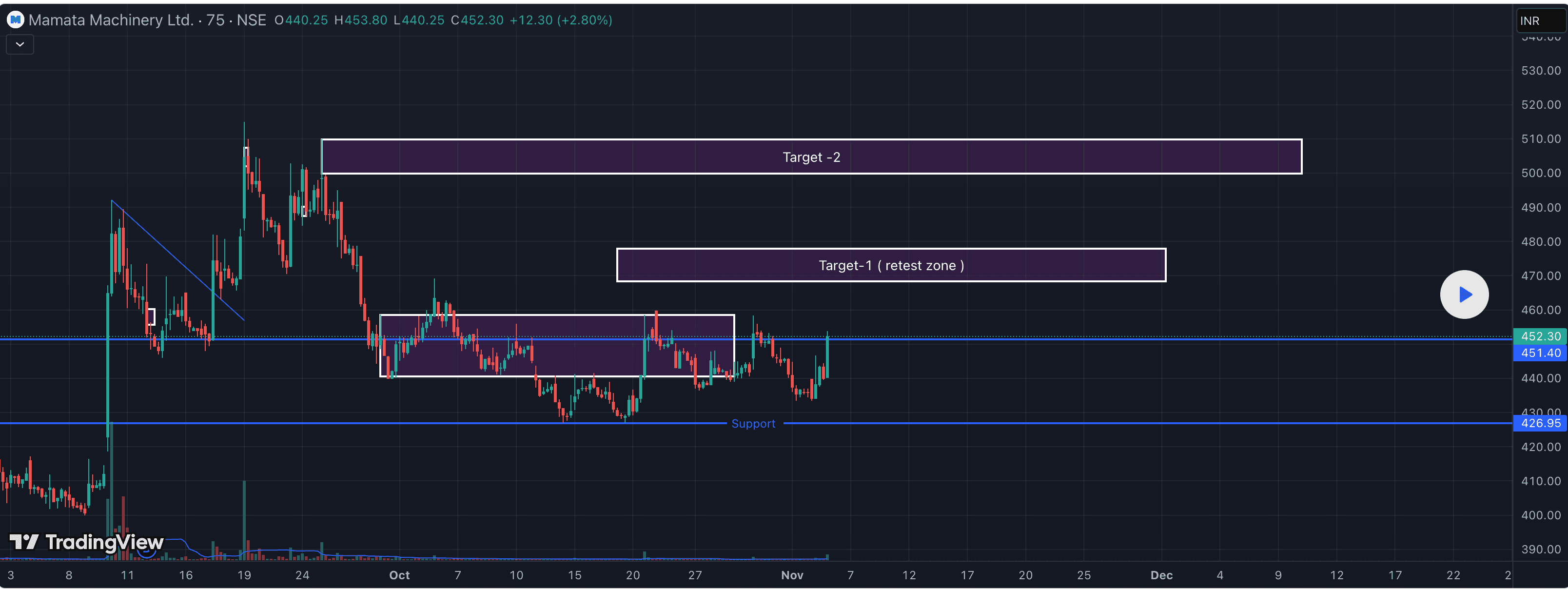
The chart of Mamata Machinery Ltd. (NSE) provides an interesting example of how price behavior, support, and retest zones can help traders understand market psychology.
As visible in the chart, the price recently rebounded from a well-defined support zone near ₹426–₹430 levels, after a phase of sideways consolidation.
This setup is often used by traders to identify early signs of momentum or trend reversal — not to predict the future, but to understand how markets typically react in such scenarios.
The Role of Support
The support level marked around ₹426.95 acts as a price zone where buying interest tends to increase.
Each time the stock approaches this region, demand often reappears, helping prices stabilize or bounce.
In simple terms, a support level represents an area where:
- Buyers see value,
- Sellers begin to lose strength, and
- The market finds temporary balance.
This is why understanding support zones is crucial — they often indicate market confidence and institutional accumulation.
Identifying the Retest Zone (Target 1)
Above the support, the chart highlights a Target-1 zone, labeled as a “retest area.”
A retest happens when a stock that previously fell from a certain price range climbs back to test it again — this time from below.
Such retests are critical because:
- They show whether sellers are still active at that price range.
- If prices hold steady or break above, it signals a shift in control from sellers to buyers.
- It gives insights into short-term sentiment change.
The Target-1 zone around ₹470–₹490 (approximate range based on the chart) is a region where price may face mild hesitation before moving further upward. This happens because earlier sellers may re-enter or take profits, testing the strength of new buyers.
The Upper Resistance (Target 2)
The chart also highlights a Target-2 zone — a broader resistance range near ₹505–₹515.
This is the area where price struggled previously, creating a supply zone.
If the price eventually reaches this area, traders often observe:
- Whether volume increases (indicating renewed interest),
- Or if the stock forms a pause or pullback pattern.
These observations don’t predict future moves — instead, they help in learning how market participants behave around major price levels.
Consolidation Before Movement
Notice how the chart shows a long horizontal consolidation phase before the recent upward candle.
Consolidation is a period where the market moves in a tight range, showing uncertainty or indecision.
During this time:
- Volume often decreases,
- Price volatility narrows, and
- Both buyers and sellers wait for confirmation.
Once price breaks above this range with momentum, it’s seen as an early sign that demand is increasing again.
Such breakouts, followed by a retest of the same range, are considered classic examples of how accumulation transitions into momentum.
Understanding Price Behavior
This setup offers several lessons for beginners learning technical analysis:
- Support and Resistance — Every stock has natural boundaries where prices tend to react.
- Breakout and Retest — When price moves above a resistance, it often retests that same level before continuing.
- Market Psychology — Support levels reflect confidence; resistance levels reflect caution.
- Volume Confirmation — Strong moves accompanied by higher volume are generally more reliable.
By studying such examples, investors can build a deeper understanding of how markets reflect collective decision-making.
Reading the Mamata Machinery Setup
In this case, Mamata Machinery’s recent move above the lower range shows:
- Buying interest is gradually returning.
- The ₹426 level continues to hold as reliable support.
- The next short-term observation zone lies near ₹470–₹490 (Target 1).
If momentum sustains, the stock could revisit the ₹505–₹515 range, where broader resistance exists — not as a prediction, but as a technical observation of previous price memory.
Broader Market Reflection
This kind of setup is common across mid-cap and small-cap industrial stocks.
Periods of sideways movement followed by gradual accumulation often precede trend shifts, especially when supported by volume spikes and broader market strength.
By learning from such examples, readers can apply similar logic to analyze other stocks without relying on complex indicators.
Key Takeaways for Learners
- Patience during consolidation can reveal important accumulation phases.
- Support levels are best identified by repeated reactions in price history.
- Retest zones act as checkpoints for trend continuation.
- Resistance is not a fixed number but a region shaped by past reactions.
Charts like this teach us to focus more on behavior than on predictions — helping traders and investors become more data-aware and disciplined.
Final Thoughts
The Mamata Machinery chart is a great educational reference for anyone studying how support, retests, and breakout structures work together.
It illustrates the power of patience and observation in market analysis.
Learning to read these patterns helps individuals understand price psychology, which is the foundation of smart investing and trading behavior.
Disclaimer: This blog is for educational purposes only. It does not provide investment or trading advice. Readers are encouraged to perform their own analysis or consult financial experts before making market-related decisions.